Anti-ALB Monoclonal Antibody
Ordering
Available Variants| Availability & Stock | Pack | SKU | Price (EUR) |
|---|---|---|---|
|
Available – Dispatch in 14 days
Global Network - International delivery
|
50ul | CAB.10410-50ul | €272.50 |
|
Available – Dispatch in 14 days
Global Network - International delivery
|
100ul | CAB.10410-100ul | €437.50 |
| Catalog No | CAB.10410 |
|---|---|
| Product Name | Anti-ALB Monoclonal Antibody |
| Isotype | IgG1 |
| Calculated MW | 45/47/69kDa |
| Immunogen | Purified Human ALB |
| Public Immunogen Range | N/A |
| Host | Mouse |
| Clone Type | Monoclonal Antibody |
| Reactivity | Human |
| Application | ELISA;WB |
| Subcellular Location | Secreted |
| Purification Method | CABfinity purification |
| Storage Buffer | PBS with 0.02% sodium azide,0.5% BSA,50% glycerol,pH7.3. |
| Storage | Store at -20℃. Avoid freeze / thaw cycles. |
Background
Albumin is a soluble,monomeric protein which comprises about one-half of the blood serum protein.Albumin functions primarily as a carrier protein for steroids,fatty acids,and thyroid hormones and plays a role in stabilizing extracellular fluid volume.Albumin is a globular unglycosylated serum protein of molecular weight 65,000.Albumin is synthesized in the liver as preproalbumin which has an N-terminal peptide that is removed before the nascent protein is released from the rough endoplasmic reticulum.The product,proalbumin,is in turn cleaved in the Golgi vesicles to produce the secreted albumin.[provided by RefSeq,Jul 2008]
Protocol / Instructions
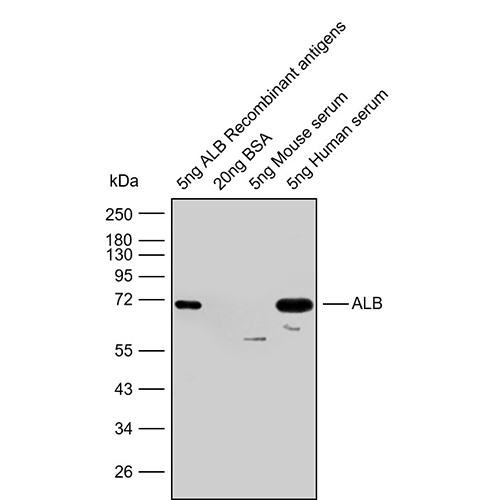
The Anti-ALB Monoclonal Antibody is a mouse-derived antibody that recognizes human albumin (ALB). This antibody has been validated for use in ELISA and Western Blotting (WB) applications.
Reagents or buffers: RIPA buffer, protease inhibitors, reducing agent, transfer buffer, blocking buffer, and ECL substrate.
Sample preparation: Prepare cell or tissue lysates in RIPA buffer with protease inhibitors. Separate proteins by SDS-PAGE and transfer to a PVDF membrane.
Antibody incubation: Incubate the membrane with the Anti-ALB Monoclonal Antibody at a dilution of 1:500-1000 in blocking buffer for 1-2 hours at room temperature or overnight at 4°C.
Washing or detection: Wash the membrane with TBST and detect using an HRP-conjugated secondary antibody and ECL substrate.
Technical notes: The expected band size for ALB is approximately 65 kDa.
Reagents or buffers: coating buffer, blocking buffer, sample diluent, and TMB substrate.
Sample preparation: Prepare serum or plasma samples by diluting them in sample diluent.
Antibody incubation: Coat an ELISA plate with the Anti-ALB Monoclonal Antibody at a dilution of 1:10000 in coating buffer. Incubate the plate with the diluted samples for 1-2 hours at room temperature.
Washing or detection: Wash the plate with PBST and detect using an HRP-conjugated secondary antibody and TMB substrate.
Technical notes: The Anti-ALB Monoclonal Antibody can be used as a capture or detection antibody in sandwich ELISA assays.
Precautions
Store at -20°C. Handle with care, as the antibody is sensitive to temperature and light. Use appropriate controls and optimize antibody dilutions for each application to ensure specific and sensitive detection of the target protein.
Validation Images