Anti-ATP1A1 Polyclonal Antibody
Ordering
Available Variants| Availability & Stock | Pack | SKU | Price (EUR) |
|---|---|---|---|
|
Available – Dispatch in 14 days
Global Network - International delivery
|
50ul | CAB.36953-50ul | €200.00 |
|
Available – Dispatch in 14 days
Global Network - International delivery
|
100ul | CAB.36953-100ul | €335.00 |
| Catalog No | CAB.36953 |
|---|---|
| Product Name | Anti-ATP1A1 Polyclonal Antibody |
| Isotype | IgG |
| Calculated MW | 113/74kDa |
| Immunogen | A synthetic peptide of human ATP1A1 |
| Public Immunogen Range | N/A |
| Host | Rabbit |
| Clone Type | Polyclonal Antibody |
| Reactivity | Mouse;Rat;Human |
| Application | IHC-P |
| Subcellular Location | Cytoplasm |
| Purification Method | CABfinity purification |
| Storage Buffer | pH7.4 PBS,0.05% NaN3,40% Glycerol. |
| Storage | Store at -20℃. Avoid freeze/thaw cycles. |
Background
The protein encoded by this gene belongs to the family of P-type cation transport ATPases, and to the subfamily of Na+/K+ -ATPases. Na+/K+ -ATPase is an integral membrane protein responsible for establishing and maintaining the electrochemical gradients of Na and K ions across the plasma membrane. These gradients are essential for osmoregulation, for sodium-coupled transport of a variety of organic and inorganic molecules, and for electrical excitability of nerve and muscle. This enzyme is composed of two subunits, a large catalytic subunit (alpha) and a smaller glycoprotein subunit (beta). The catalytic subunit of Na+/K+ -ATPase is encoded by multiple genes. This gene encodes an alpha 1 subunit. Multiple transcript variants encoding different isoforms have been found for this gene.
Protocol / Instructions
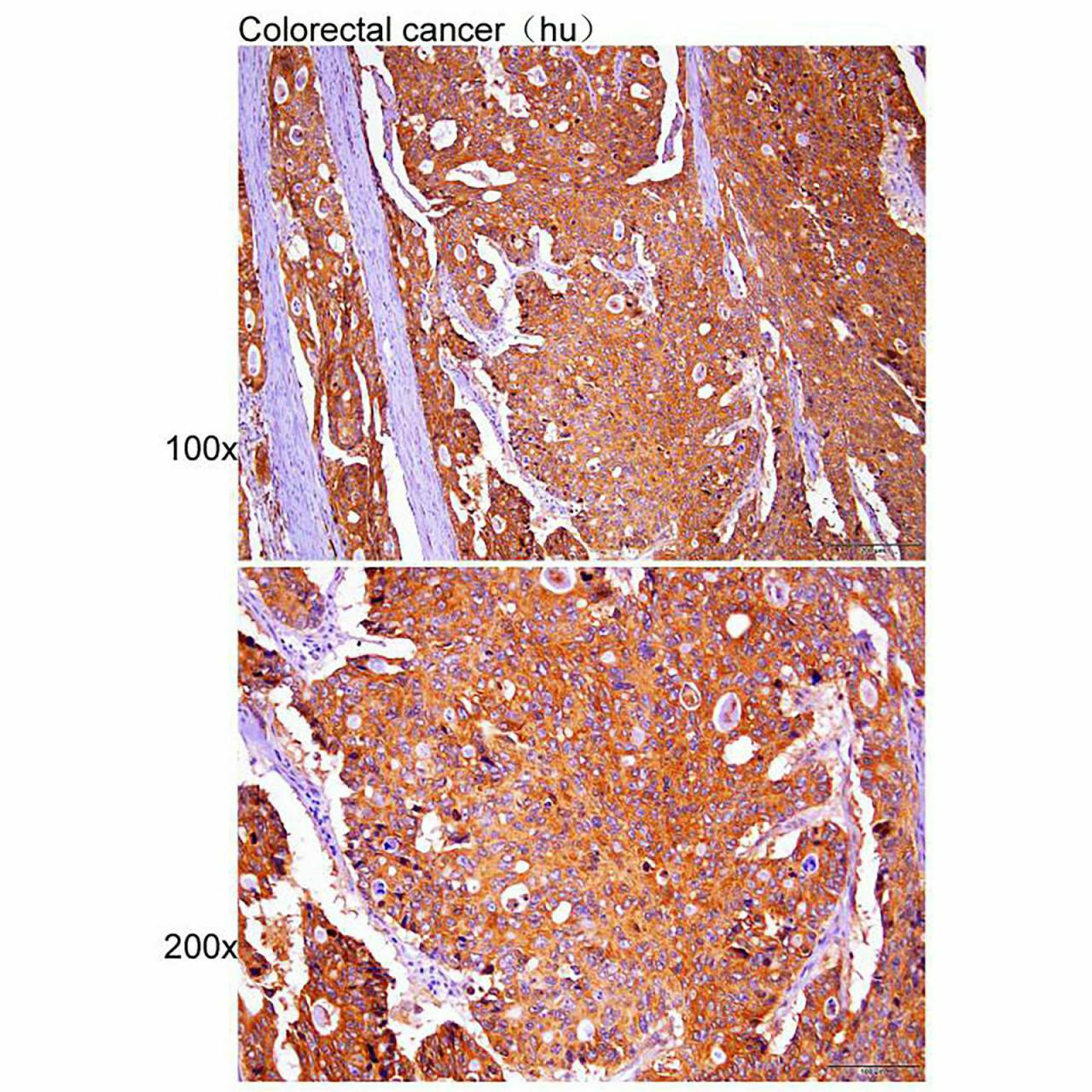
The Anti-ATP1A1 Polyclonal Antibody is a rabbit-derived antibody that recognizes the ATP1A1 protein in mouse, rat, and human samples. This antibody has been validated for use in Immunohistochemistry-Paraffin (IHC-P) applications.
Reagents or buffers: Xylene, ethanol, antigen retrieval buffer, blocking buffer, primary antibody (Anti-ATP1A1 Polyclonal Antibody), secondary antibody, and chromogen.
Sample preparation: Paraffin-embedded tissue sections are deparaffinized in xylene and rehydrated through a series of ethanol washes. Antigen retrieval is performed using a suitable buffer.
Antibody incubation: The primary antibody is applied at a recommended dilution of 1:25-100 and incubated for a suitable duration.
Washing or detection: The sections are washed and a secondary antibody is applied, followed by a chromogen to visualize the staining.
Technical notes: Optimization of the primary antibody dilution and incubation time may be necessary to achieve the best results.
Precautions for handling and use of the Anti-ATP1A1 Polyclonal Antibody will be provided in the precautions section below.
Precautions
Store at -20°C. Handle with care, and avoid repeated freeze-thaw cycles. Optimize antibody dilution and incubation times for best results.
Validation Images