Anti-A1BG Polyclonal Antibody
Ordering
Available Variants| Availability & Stock | Pack | SKU | Price (EUR) |
|---|---|---|---|
|
Available – Dispatch in 14 days
Global Network - International delivery
|
50ul | CAB.83801-50ul | €200.00 |
|
Available – Dispatch in 14 days
Global Network - International delivery
|
100ul | CAB.83801-100ul | €335.00 |
| Catalog No | CAB.83801 |
|---|---|
| Product Name | Anti-A1BG Polyclonal Antibody |
| Isotype | IgG |
| Calculated MW | 54kDa |
| Immunogen | A synthetic peptide of human A1BG |
| Public Immunogen Range | N/A |
| Host | Rabbit |
| Clone Type | Polyclonal Antibody |
| Reactivity | Human |
| Application | WB |
| Subcellular Location | secreted |
| Purification Method | CABfinity purification |
| Storage Buffer | pH7.4 PBS,0.05% NaN3,40% Glycerol. |
| Storage | Store at -20℃. Avoid freeze/thaw cycles. |
Background
Alpha-1-B glycoprotein is a protein in humans that is encoded by the A1BG gene. The protein encoded by this gene is a plasma glycoprotein of unknown function. The protein shows sequence similarity to the variable regions of some immunoglobulin supergene family member proteins.
Protocol / Instructions
The Anti-A1BG Polyclonal Antibody is a rabbit-derived antibody raised against a synthetic peptide of human A1BG. This antibody is recommended for use in Western Blotting (WB) applications.
Reagents or buffers required include the Anti-A1BG Polyclonal Antibody, a secondary antibody conjugated to a detection system (e.g., HRP), sample buffer, running buffer, transfer buffer, and a blocking buffer (e.g., 5% non-fat dry milk in TBS-T).
Sample preparation involves lysing cells or tissues in a suitable lysis buffer, followed by protein quantification and mixing with sample buffer.
Antibody incubation involves diluting the Anti-A1BG Polyclonal Antibody to 1:200-1000 in the blocking buffer and incubating the membrane with this solution for 1-2 hours at room temperature or overnight at 4°C.
Washing involves rinsing the membrane with TBS-T CABter antibody incubation, followed by incubation with the secondary antibody.
Technical notes: Optimize the antibody dilution and incubation time for best results. Use a positive control to confirm the specificity of the antibody.
Precautions
Store at -20°C, handle with care, use appropriate controls, and optimize antibody dilution and incubation time for best results.
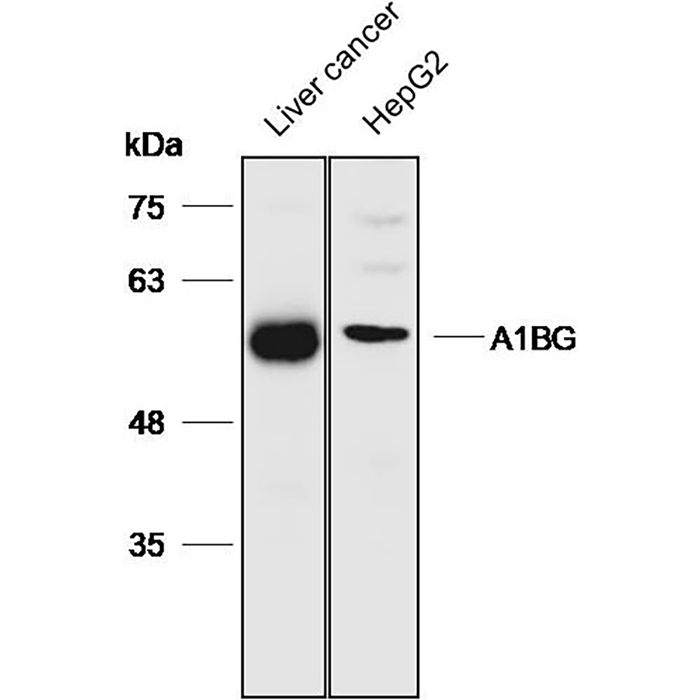
Validation Images